
Drywall Repair or Replace: How to Decide in an Older Home
Usually, you can patch it. A doorknob hole, a crack down a seam, popped screws, a small water stain: a patch, some joint compound and paint, and it's gone. You replace when the damage is spread wide, when water's left the board soft or crumbling, or when there's mold. Older New Hampshire houses add one more case. Sometimes it isn't drywall. It's plaster over wood lath, and then the repair changes, and so do the precautions, most of all in a house built before 1978.
When a patch is enough
Small, dry damage is patch territory. A hole the size of a fist, a crack running off a door corner, a dent from moving furniture, a line of popped nail heads across a ceiling. These are fixed by cutting clean edges, backing the hole if needed, taping, then two or three thin coats of compound sanded smooth before primer and paint.
The skill is in the finish. A patch that is flat and feathered out wide disappears under paint. One that is lumpy or ridged shows every time the afternoon light comes across the wall. Matching the texture on a ceiling, and priming the patch so the paint sheen does not flash, are what separate a repair you can find from one you cannot.
Drywall repair and paint are the jobs customers ask Crimson Maple Construction for most. In Devin Ouellette's own words, the top request is "Drywall repair and Paint work." That makes sense. Doorknobs, furniture, settling and small leaks are the most common kinds of wear in any lived-in house.
When a wall or ceiling needs new board
Water changes the answer. Wet once, dried out, just a stain left? A coat of stain-blocking primer and some paint often does it. But if the board's soft, or sagging, or the paper's crumbling, or it smells musty, it's lost its strength. Out it comes. Ceilings are the ones to watch, because wet board overhead can sag and drop. If a ceiling is bellied down with water above it, keep people out from under it and deal with the leak before anything else.
Mold on the back of the board is another reason to replace. If it is visible on the face, there is usually more behind it. Cut out past the damaged area to sound material, let the framing and insulation dry fully, and find and fix the source of the water before hanging anything new.
Large areas of damage are often faster and cleaner to re-sheet than to patch piece by piece. So are ceilings with a lot of cracked tape, or walls with several old repairs layered on top of each other until nothing lies flat. At some point a new sheet is less work than chasing the last patch.
Plaster and lath in 1800s and 1900s houses
A lot of the older housing around Manchester was built before drywall was common. Devin describes the area's homes as "mostly town-houses older 1800-1900s homes." In a lot of those houses the walls are plaster, troweled onto thin wood strips called lath. Plaster isn't drywall. It's harder. It's heavier. Cut it wrong and it doesn't forgive you.
If it's cracked but still holding tight, it can be fixed. If it's pulled away from the lath (bulging, or hollow-sounding when you knock) it may need plaster washers to pin it back, or cutting back to where it's solid. Small holes often get a piece of drywall, shimmed out until it's flush with the thicker plaster around it.
Replacing a whole plaster wall? Bigger job than you'd think. Tear-out is heavy and dusty, the debris piles up quick, and there's the old paint, which brings in the lead question further down. So some owners skip the tear-out and hang new drywall right over plaster that's still sound. The catch: trim depth changes at every door and window.
Damp rooms: bathrooms and basements
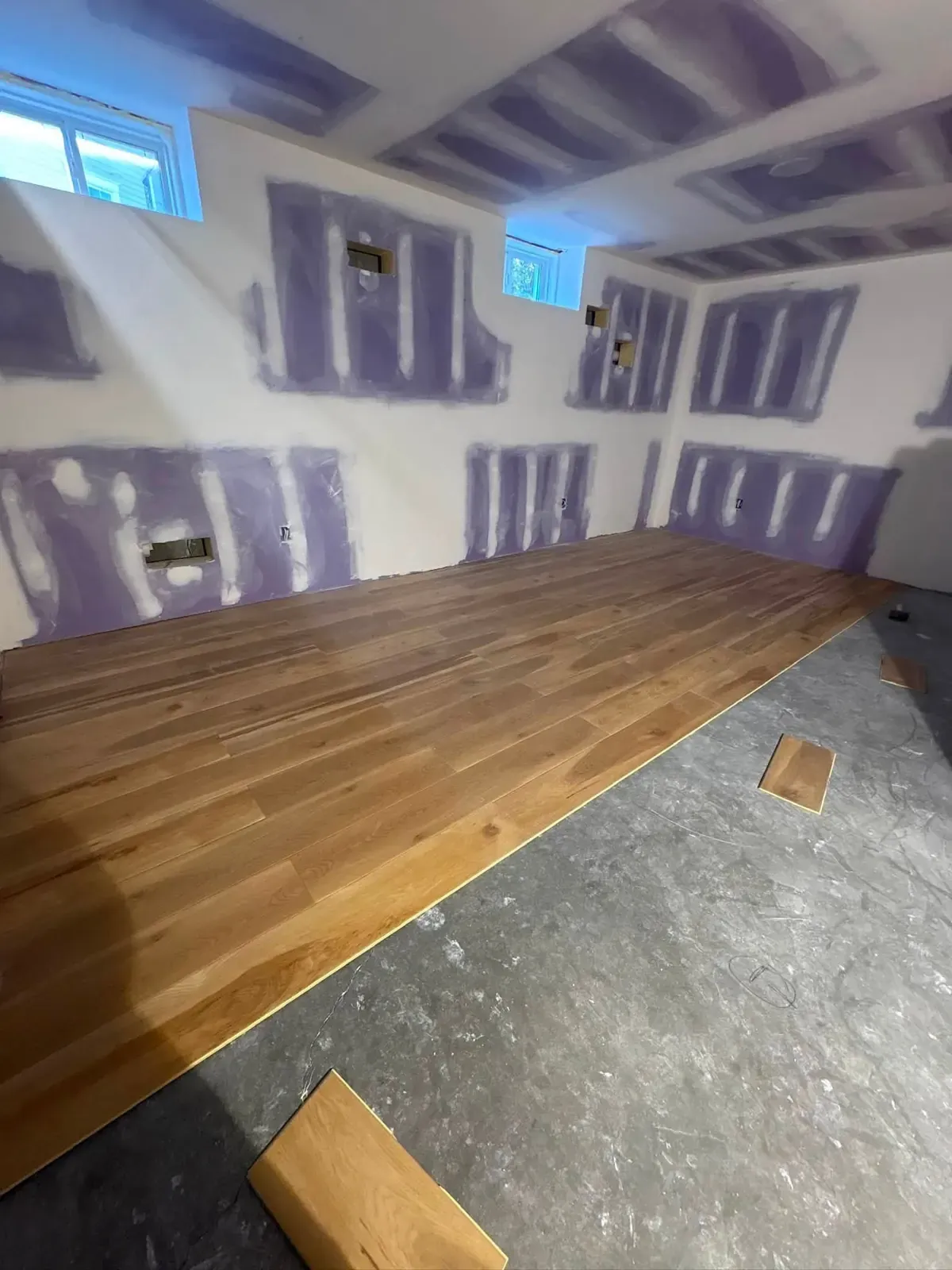
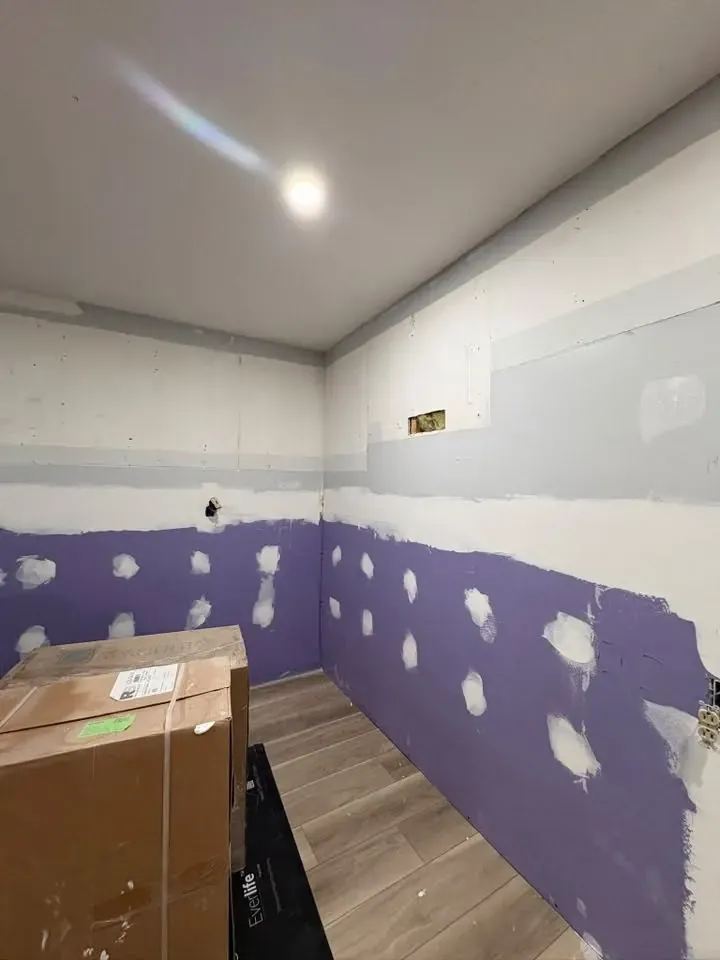
Regular drywall is gypsum with a paper face, and it hates moisture. For bathrooms, laundry rooms and finished basements, people usually use moisture- and mold-resistant board. On a lot of those products the facing is colored, often green or purple, so you can see them on the wall before the paint goes on. One of Crimson Maple's own job photos shows purple board going up on the walls and ceiling of a basement room.
Behind tile in a tub or shower, the International Residential Code, which New Hampshire adopts, calls for a cement, fiber-cement or glass-mat gypsum backer rather than ordinary drywall. The moisture-resistant stuff goes on the rest of the room. Not inside the shower. Put the wrong board in there and a few years on, the tile starts coming loose.
Water damage in a basement, or below a bathroom? Before any patching, track down where the water came from. A slow drip at a supply line, a failed tub seal, or a foundation that lets water in during spring melt will all ruin new board the same way they ruined the old. A new wall over an old leak just starts the clock again.
Lead dust in pre-1978 walls
Built before 1978? Then there may be lead paint somewhere under the newer coats. Sand joint compound over it and it turns to fine dust. Same if you cut out a chunk of plaster, or knock a wall down. That dust ends up on the floors and the sills.
Under the EPA Renovation, Repair and Painting rule, if you pay someone to disturb painted surfaces in a pre-1978 home, they have to be a certified firm, and the workers have to be trained. Ask any contractor for that certificate before work starts, and ask how dust will be contained and cleaned. Our guide on lead paint in older New Hampshire homes explains more.
This matters most on the small jobs people do not think of as renovation. Sand a few patches before you paint the bedroom. Cut a hole to get at a leaky pipe. Tiny jobs, but they can throw a surprising amount of dust. Doing that yourself in an older home? Keep the kids out of the room. Don't dry sand. And skip the broom: clean up with a HEPA vacuum and damp cloths. For drywall repair, painting, or an urgent repair after a leak around Manchester, call (603) 722-3344. Message us a photo — we’ll get you a number.
Questions people actually ask
- Can water-damaged drywall be repaired?
Sometimes. Got wet one time, dried, still firm? Stain-blocking primer and a fresh coat of paint might be the whole job. Soft, sagging, crumbling, musty? Then it's lost its strength; cut it out and replace it. Either way, fix the leak first and let the framing dry out before new board goes up.
- Should I repair plaster walls or replace them with drywall?
Cracked, but still stuck tight to the lath? Usually fixable. If it bulges or sounds hollow, it's come loose, and you're looking at re-anchoring or cutting back. Ripping it all out is heavy and dusty, and in a pre-1978 house it can stir up lead paint. That's why a lot of owners just patch the bad spots, or hang drywall over the plaster that's still sound.
- What drywall should go in a bathroom or basement?
For bathrooms, laundry rooms and finished basements, most people use moisture- and mold-resistant board. You'll spot it easily; it's often green or purple. Inside a tub or shower, behind tile, the International Residential Code calls for a cement, fiber-cement or glass-mat gypsum backer instead of ordinary drywall.
- Is it safe to sand drywall patches in an old house?
In a house built before 1978, sanding near old painted surfaces can create lead dust. Paying someone to do it? Then the EPA Renovation, Repair and Painting rule says it has to be a certified firm, with trained workers. Get the certificate. Then ask how they'll seal off the area, and how they'll clean up. Testing the paint first can also help.
Before hiring anyone for this kind of work, it is worth reading what New Hampshire does and does not license and how a written quote should read. About Crimson Maple Construction covers who would be doing the work.
The work this guide is about
- Drywall repairDrywall repair and installation in Manchester, NH: holes, cracks, water stains, old plaster walls and new board, taped and ready for paint.
- PaintingInterior and exterior painting in Manchester, NH: prep, patching, priming and finish coats for older homes, with lead-safe rules for pre-1978 houses.
- Emergency repairsEmergency home repairs in Manchester, NH: water-damaged subfloor and drywall, storm damage to siding and roofs, doors that won’t lock. What to do first.
The other guides
- Hiring a Contractor in New Hampshire: What to Check Before You SignNH doesn't license general contractors. So "are you licensed?" gets you nowhere. Ask these four things instead.
- Manchester NH Building Permits: What Homeowners Should KnowManchester's Building Division, decks, electrical, who pulls the permit. And the one phone call that settles it.
- Lead Paint in Older New Hampshire Homes: Renovating SafelyBuilt before 1978? Then sanding, scraping and old windows come with federal rules. Here's what to ask first.
- Ice Dams and Roof Snow in New Hampshire: Causes and FixesSame roof, same icicles, every February. Why it keeps happening, what to do with the snow today, and the actual fix.
- LVP, Tile or Hardwood: Choosing Floors for a New Hampshire HomeBasement, bathroom, mudroom. Slush and salt on the way in. Which floor survives where, and why the subfloor matters.
Manchester, NH
Tell us what the house needs
Call and describe the job. If it is on the service list, ask how it would go. Foundation work and concrete pads are not on it.